Muutke küpsiste eelistusi

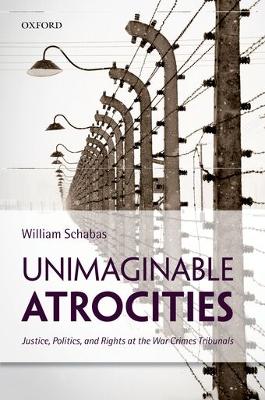
E-raamat: Unimaginable Atrocities: Justice, Politics, and Rights at the War Crimes Tribunals

(Professor of International Law, University of Middlesex)
  • Formaat: PDF+DRM
  • Ilmumisaeg: 23-Feb-2012
  • Kirjastus: Oxford University Press
  • Keel: eng
  • ISBN-13: 9780191612213
  • Formaat - PDF+DRM
  • Hind: 38,27 €*
  • * hind on lõplik, st. muud allahindlused enam ei rakendu
  • Lisa ostukorvi
  • Lisa soovinimekirja
  • See e-raamat on mõeldud ainult isiklikuks kasutamiseks. E-raamatuid ei saa tagastada.
  • Raamatukogudele
    • Oxford Scholarship Online e-raamatud
  • Formaat: PDF+DRM
  • Ilmumisaeg: 23-Feb-2012
  • Kirjastus: Oxford University Press
  • Keel: eng
  • ISBN-13: 9780191612213

DRM piirangud

  • Kopeerimine (copy/paste):

    ei ole lubatud

  • Printimine:

    ei ole lubatud

  • Kasutamine:

    Digitaalõiguste kaitse (DRM)
    Kirjastus on väljastanud selle e-raamatu krüpteeritud kujul, mis tähendab, et selle lugemiseks peate installeerima spetsiaalse tarkvara. Samuti peate looma endale  Adobe ID Rohkem infot siin. E-raamatut saab lugeda 1 kasutaja ning alla laadida kuni 6'de seadmesse (kõik autoriseeritud sama Adobe ID-ga).

    Vajalik tarkvara
    Mobiilsetes seadmetes (telefon või tahvelarvuti) lugemiseks peate installeerima selle tasuta rakenduse: PocketBook Reader (iOS / Android)

    PC või Mac seadmes lugemiseks peate installima Adobe Digital Editionsi (Seeon tasuta rakendus spetsiaalselt e-raamatute lugemiseks. Seda ei tohi segamini ajada Adober Reader'iga, mis tõenäoliselt on juba teie arvutisse installeeritud )

    Seda e-raamatut ei saa lugeda Amazon Kindle's. 

As international criminal courts and tribunals have proliferated and international criminal law is increasingly seen as a key tool for bringing the world's worst perpetrators to account, the controversies surrounding the international trials of war criminals have grown. War crimes tribunals have to deal with accusations of victor's justice, bad prosecutorial policy and case management, and of jeopardizing fragile peace in post-conflict situations. In this exceptional book, one of the leading writers in the field of international criminal law explores these controversial issues in a manner that is accessible both to lawyers and to general readers.

Professor William Schabas begins by considering the discipline of international criminal law, outlining the differing approaches to the description of international crimes and examining the frequent claims relating to the retroactive application of these crimes. The book then discusses the relationship between genocide and crimes against humanity, studying the fascination with what Schabas calls the 'genocide mystique'. International criminal tribunals have often been stigmatized as an exercise in victor's justice. This book traces how this critique developed and the difficulty it poses to the identification of situations for prosecution by the International Criminal Court. The claim that amnesty for international crimes is prohibited by international law is challenged, with a more nuanced approach to the relationship between justice and peace being proposed. Throughout the book there is a strong historical perspective, with constant reference to the early experiments in international justice at Nuremberg and Tokyo. The work also analyses the growing pains of the International Criminal Court as it enters its second decade.

Arvustused

Schabas has truly outdone himself in his latest offering. Rather than throwing out the laptop (with the guitar), Schabass work should encourage others to pick up the pen, the phone or the tablet and work to fulfil Ferenczs goalsa world of tolerance through, at least in part, international criminal lawjust as Schabas continues to do. * Matthew Kane, International Affairs 89 * Schabas has long contributed to the development of effective world law. He has taken on the task and made it his own, standing shoulder to shoulder with the likes of Cherif Bassiouni, Antonio Cassese, Hans Corell, Michael Scharf and David Scheffer. His text is plainly intended to appeal to and inform, not only academics, but also those with less direct expertise in the field. This is not to suggest that it is somehow written at an introductory level, or that it can be passed over by those more familiar with the issues addressed in the book. Rather, it seeks to expand the audience, educating those interested in creating a safer and more tolerant world on key components within the field of international criminal law, while providing substantive arguments for discussion among academic circles. * Matthew Kane, International Affairs 89 * Schabas proves an expansive (historical) background knowledge and provides the reader with a fresh view to a number of âgivensâ in international criminal law. * Jane A. Hofbauer, Austrian Review of International and European Law * In Unimaginable Atrocities, Schabas has produced perhaps his greatest work in a prodigious collection of extraordinary contributions to the field. * Matthew Kane, International Affairs 89 *

Introduction 1(24)
1 `Unimaginable Atrocities': Identifying International Crimes
25(22)
2 Nullum Crimen Sine Lege
47(26)
3 Victors' Justice? Selecting Targets for Prosecution
73(26)
4 The Genocide Mystique
99(26)
5 Mens Rea, Actus Reus, and the Role of the State
125(28)
6 History, International Justice, and the Right to Truth
153(20)
7 No Peace Without Justice? The Amnesty Quandary
173(26)
8 Crimes Against Peace
199(24)
Index 223
Professor William A. Schabas is professor of international law at Middlesex University in London. He also has appointments at the National University of Ireland Galway, where he is professor of human rights law, at the Chinese Academy of Social Sciences, in Beijing, as honorary professor, Kellogg College of the University of Oxford, where he is a visiting fellow, and at the Université du Québec à Montréal, as professeur associé. Prof. Schabas practices from the chambers of 9 Bedford Row, in London.