Muutke küpsiste eelistusi

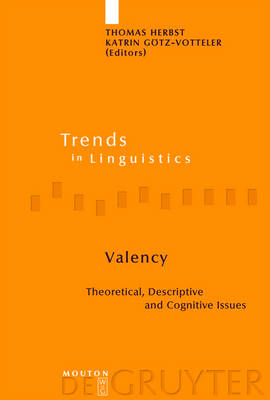
E-raamat: Valency: Theoretical, Descriptive and Cognitive Issues

Teised raamatud teemal:
  • Formaat - PDF+DRM
  • Hind: 201,66 €*
  • * hind on lõplik, st. muud allahindlused enam ei rakendu
  • Lisa ostukorvi
  • Lisa soovinimekirja
  • See e-raamat on mõeldud ainult isiklikuks kasutamiseks. E-raamatuid ei saa tagastada.
Teised raamatud teemal:

DRM piirangud

  • Kopeerimine (copy/paste):

    ei ole lubatud

  • Printimine:

    ei ole lubatud

  • Kasutamine:

    Digitaalõiguste kaitse (DRM)
    Kirjastus on väljastanud selle e-raamatu krüpteeritud kujul, mis tähendab, et selle lugemiseks peate installeerima spetsiaalse tarkvara. Samuti peate looma endale  Adobe ID Rohkem infot siin. E-raamatut saab lugeda 1 kasutaja ning alla laadida kuni 6'de seadmesse (kõik autoriseeritud sama Adobe ID-ga).

    Vajalik tarkvara
    Mobiilsetes seadmetes (telefon või tahvelarvuti) lugemiseks peate installeerima selle tasuta rakenduse: PocketBook Reader (iOS / Android)

    PC või Mac seadmes lugemiseks peate installima Adobe Digital Editionsi (Seeon tasuta rakendus spetsiaalselt e-raamatute lugemiseks. Seda ei tohi segamini ajada Adober Reader'iga, mis tõenäoliselt on juba teie arvutisse installeeritud )

    Seda e-raamatut ei saa lugeda Amazon Kindle's. 

In recent years, research on valency has led to important insights into the nature of language. Some of these findings are published in this volume for the first time with up-to-date accounts of language description and new reflections on language, above all for English and German. The volume also presents examples of contrastive analysis, which are of use for all those who deal professionally with these two languages. Furthermore, the articles in the psycholinguistic and computational linguistics section demonstrate the applicability and value of valency theory for these approaches and shed light on a fruitful cooperation between theoretical and descriptive linguistics and applied disciplines. The papers cover the following aspects of valency analysis: (i) theoretical aspects of the valency approach in relation to related theories of complementation (dependency syntax, FrameNet, case roles), (ii) descriptive aspects of valency and complementation, (iii) valency as a concept for the description of cognitive processes in syntactic processing, (iv) contrastive aspects of valency, above all for English and German, and (v) possible computational applications of the valency concept in fields such as automatic syntactic recognition or language processing. The volume combines papers of representatives from different linguistic schools on the topic of complementation. One of the aims is to show how concepts developed for the analysis of one language, in the case of valency often German, can be applied to other languages such as English.

Thomas Herbst and Katrin Götz-Votteler, Universität Erlangen-Nürnberg, Germany.
Preface Valency - theoretical, descriptive and cognitive issues v
Thomas Herbst
Katrin Gotz-Votteler
Section 1: Theoretical and descriptive aspects of valency
The scope of valency in grammar
3(12)
Peter Matthews
Valency complements or valency patterns?
15(22)
Thomas Herbst
Describing semantic valency
37(14)
Katrin Gotz-Votteler
The status of valency patterns
51(16)
Lene Schøsler
Verb valency patterns, constructions and grammaticalization
67(18)
Dirk Noel
Aspects of a diachronic valency syntax of German
85(16)
Mechthild Habermann
The valency of experiential and evaluative adjectives
101(16)
Ilha Mindt
Valcncy rules? The case of verbs with prepositional complements
117(12)
Michael Klotz
Valency issues in FrameNet
129(34)
Charles J. Fillmore
Section 2: Cognitive issues and valency phenomena
Valency and cognition - a notion in transition
163(20)
Gert Rickheit
Lorenz Sichelschmidt
Valency grammar in mind
183(10)
Rudolf Emons
The acquisition of argument structure
193(24)
Heike Behrens
Section 3: Contrastive aspects of valency
Valency and the errors of learners of English and German
217(12)
Ian Roe
Temporary ambiguity of German and English term complements
229(24)
Klaus Fischer
Sentence patterns and perspective in English and German
253(18)
Irene Ickler
Contrasting valency in English and German
271(16)
Brigitta Mittmann
Valency in a contrastive perspective: Structure and use
287(22)
Stig Johansson
Section 4: Computational aspects of valency analysis
Valency and automatic syntactic and semantic analysis
309(12)
Dieter Gotz
Handling valency and coordination in Database Semantics
321(18)
Roland Hausser
Pronominal clitics and valency in Albanian: A computational linguistics perspective and modelling within the LAG-Framework
339(14)
Besim Kabashi
The practical use of valencies in the Erlangen speech dialogue system CONALD
353(12)
Gunther Gorz
Bernd Ludwig
Valency data for Natural Language Processing: What can the Valecy Dictionary of English provide?
365(18)
Elrich Heid
Subject index 383(8)
Author index 391


Thomas Herbst and Katrin Götz-Votteler, Universität Erlangen-Nürnberg, Germany.