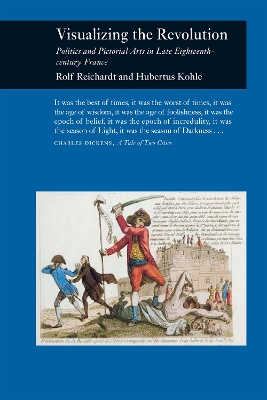
"To truly visualize the Revolution, as the authors of this fascinating book maintain, requires a study of the images found in the caricatures and pamphlets of the penny press. Indeed, Reichardt and Kohle argue that such quotidian illustrations, often made days after the event, are a more authentic reflection of the revolutions artistic culture than studio painting, which, owing to the rush of circumstances, often remained unfinished . . . The amassing of this unfamiliar trove, the decipherment of often-arcane examples, and the analysis of their relation to revolutionary discourse are the major contributions of this study. Highly recommended." - Choice "the most original and thought-provoking analysis yet seen of revolutionary prints." - Journal of Modern History "As a subtitle Politics and the Pictorial Arts hardly does justice to the breadth of Rolf Reichardt and Hubertus Kohles sweeping review of Revolutionary visual culture. From the opening account of the procession that accompanied Voltaires remains to the Panthéon in July 1791 to the conclusion's remarks on Revolutionary board games, Visualizing the Revolution adopts an admirably encyclopaedic approach to its subject. Describing the Revolution as amulti-media event, the authors go well beyond the purely pictorial to embrace everything from Revolutionary ritual, architecture and artefacts to the politics of the Salon and the eighteenth-centurys aesthetic debates . . . an impressively wide-ranging and assured work." - French History "the book navigates admirably between the dynamics of the Revolution and the vast array of objects that visualized them. Historians and art historians alike of eighteenth-century France will no doubt receive the volume as a welcome contribution to the field and, perhaps most of all, as a pedagogical resource." - CAA Reviews "The books exquisite production value - with 187 illustrations, 46 in color - its luxuriously heavy paper stock, and extensive bibliography make this volume a must for anyone seeking new insights into the pictorial culture of 1789-99 . . . unmarred by jargon, and following a lucid and well organized structure . . . Conceptually original and consistently interesting, Visualizing the Revolution is destined to become a classic." - Eighteenth Century Studies "A new contribution and approach . . . this publication is a useful step in understanding not only the changes in printmaking at the end of the eighteenth century, but also the complex discourse surrounding it." - Print Quarterly

 Lisainfo e-raamatute kohta