Muutke küpsiste eelistusi

E-raamat: Watlington Hoard: Coinage, Kings and the Viking Great Army in Oxfordshire, AD875-880

(University of Oxford), (University of Oxford)
  • Formaat: 260 pages
  • Ilmumisaeg: 16-Jun-2022
  • Kirjastus: Archaeopress Archaeology
  • Keel: eng
  • ISBN-13: 9781789698305
  • Formaat - PDF+DRM
  • Hind: 4,08 €*
  • * hind on lõplik, st. muud allahindlused enam ei rakendu
  • Lisa ostukorvi
  • Lisa soovinimekirja
  • See e-raamat on mõeldud ainult isiklikuks kasutamiseks. E-raamatuid ei saa tagastada.
  • Formaat: 260 pages
  • Ilmumisaeg: 16-Jun-2022
  • Kirjastus: Archaeopress Archaeology
  • Keel: eng
  • ISBN-13: 9781789698305

DRM piirangud

  • Kopeerimine (copy/paste):

    ei ole lubatud

  • Printimine:

    ei ole lubatud

  • Kasutamine:

    Digitaalõiguste kaitse (DRM)
    Kirjastus on väljastanud selle e-raamatu krüpteeritud kujul, mis tähendab, et selle lugemiseks peate installeerima spetsiaalse tarkvara. Samuti peate looma endale  Adobe ID Rohkem infot siin. E-raamatut saab lugeda 1 kasutaja ning alla laadida kuni 6'de seadmesse (kõik autoriseeritud sama Adobe ID-ga).

    Vajalik tarkvara
    Mobiilsetes seadmetes (telefon või tahvelarvuti) lugemiseks peate installeerima selle tasuta rakenduse: PocketBook Reader (iOS / Android)

    PC või Mac seadmes lugemiseks peate installima Adobe Digital Editionsi (Seeon tasuta rakendus spetsiaalselt e-raamatute lugemiseks. Seda ei tohi segamini ajada Adober Reader'iga, mis tõenäoliselt on juba teie arvutisse installeeritud )

    Seda e-raamatut ei saa lugeda Amazon Kindle's. 

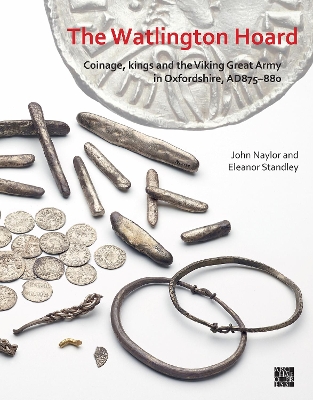
The Watlington Hoard was discovered in southern Oxfordshire in 2015 by a metal-detectorist, and acquired by the Ashmolean Museum, Oxford in 2017. A nationally-important find of coinage and metalwork, and the first major Viking-Age hoard from the county, it dates from the late 870s, a fundamental and tumultuous period in Britains history. The contents of the hoard include a highly significant collection of over 200 silver pennies, mostly of Alfred the Great, king of Wessex, and Ceolwulf II, king of Mercia, transforming our understanding of the coinage in this period, and 23 silver and gold pieces of contemporary metalwork much of which was derived from Scandinavia.


Presenting the complete publication of the objects and coins in the Watlington Hoard including an important re-assessment of the coinage of the late 870s the authors discuss its wider implications for our understanding of hoarding in late 9th-century southern Britain, interactions between the kingdoms of Wessex and Mercia, and the movements of the Viking Great Army after the Battle of Edington in 878. The book also relates another side to the hoards story, beginning with its discovery and excavation, charting its path through the conservation work and acquisition by the Ashmolean Museum to the public outreach projects which ran alongside the scholarly research into the hoard.

Arvustused

'This is an impressive volume, which demonstrates the value of collaboration between archaeologists, heritage professionals, and responsible metal-detectorists.' Murray Andrews (2023): Current Archaeology Issue 394 'On many different levels this volume on the Watlington Hoard is significant for Anglo-Saxon studies, containing interesting papers which are well-supported by numerous photographs, maps, and tables to aid interpretation.'  Barbara Yorke (2023): Oxoniensia Vol. 88 'This excellent volume provides thereby an important contribution to our growing understanding of the Viking Great Army.' Julian Richards (2023): Medieval Archaeology vol 67.1 'It is a real pleasure to welcome the publication of this very informative and well-produced volume, which puts on record in admirable detail all the component ele­ments of a major hoard of late ninth century coins, sil­ver ingots, and other related precious metal Viking-age items, found by a detectorist on Oxfordshire farmland close to the small town of Watlington in October 2015.'  Hugh Pagan (2022): British Numismatic Journal 92 Das Buch ist gut geschrieben, von einer Reihe von Expert*innen, das Bildmaterial ist hervorragend, mit informativen Karten und Fotos der Funde. Es ist sowohl für allgemein Interessierte als auch für Spezialist*innen nützlich, die sich in einzelne Fragen vertiefen möchten, z. B. zur Numismatik oder zur Objektarchäologie. Der Katalog von gut 60 Seiten legt das gesamte Material ausführlich vor, was sicherlich künftigen Generationen von Forschenden sehr willkommen sein wird. [ translated: The book is well-written by a number of experts, and the visuals are excellent, with informative maps and photos of the findings. It is useful both for the general public and for specialists who wish to delve into specific topics, such as numismatics or object archaeology. The catalog, which spans about 60 pages, presents the entire material in detail, which will certainly be greatly appreciated by future generations of researchers] Birgitta Hårdh (2023): GERMANIA 101

Foreword Xa Sturgis, Director of the Ashmolean Museum ;


Chapter 1 Introduction ;


Chapter 2 The Watlington Hoard uncovered: from discovery to acquisition and
beyond ;


Chapter 3 The archaeology and landscape of the Upper Thames Valley in the 9th
century John Naylor ;


Chapter 4 Oxfordshire, Wessex, and Mercia in the Age of Alfred the Great
Ryan Lavelle ;


Chapter 5 The coinage of Wessex and Mercia, c.87579: a re-assessment of the
Two Emperors and Cross-and-Lozenge types John Naylor ;


Chapter 6 The coins of the Watlington Hoard John Naylor with a contribution
by Simon Coupland ;


Chapter 7 The non-numismatic objects of the Watlington hoard Jane Kershaw ;


Chapter 8 Money in southern England in the 870s in the light of the
Watlington hoard Julian Baker ;


Chapter 9 The Watlington Hoard in Context John Naylor ;


Catalogue 1 The non-numismatic objects Compiled and edited by Eleanor
Standley ;


Catalogue 2 The coins John Naylor ;


Appendix 1 A revised checklist of finds of Two Emperors and Cross-and-Lozenge
type coins Compiled by John Naylor ;


Appendix 2 A visual summary guide to the classification of the Two Emperors
and Cross-and-Lozenge type pennies John Naylor ;


Appendix 3 The moneyers of the Two Emperors and Cross-and-Lozenge type
pennies ;


Appendix 4 Concordance table showing the spellings of moneyers names ;


Bibliography
Dr John Naylor is the Portable Antiquities Schemes National Finds Adviser for Early Medieval and Later Coinage, based in the Heberden Coin Room at the Ashmolean Museum, Oxford. His research focuses on the archaeology and numismatics of early medieval Europe. ;


Dr Eleanor Standley is Curator of Medieval Archaeology in the Department of Antiquities at the Ashmolean Museum, Oxford and Associate Professor of Later Medieval Archaeology in the School of Archaeology, University of Oxford. Her research focuses on the later medieval period in Britain and Europe, with a special interest in daily life and the socio-cultural significance of everyday objects.