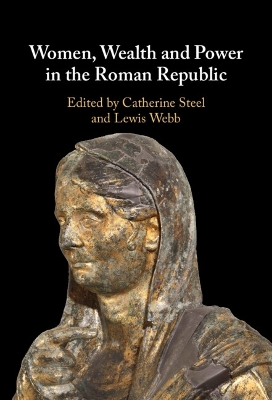
In the Roman Republic, elite women were legally permitted to control substantial assets and many demonstrably were in direct control of their wealth. They were also the mothers, wives and daughters of the politicians who built Rome's empire and, in a time of high mortality, could find themselves running households that did not contain adult men. This volume explores the political and social consequences of elite female wealth. It combines case studies of individual women, such as Licinia, wife of C. Gracchus, Mucia Tertia, Fulvia and Octavia Minor, with broader surveys of the institutional frameworks and social conventions that constrained and enabled women's wealth and its consequences. The book contributes to the recent upsurge of interest in re-evaluating the role of women in Republican Rome and will be invaluable for scholars and students alike.
Muu info
Elite women controlled substantial property in the Roman Republic and were thus empowered to participate in politics and public life.
List of Figures and Tables; Notes on Contributors; Introduction
Catherine Steel and Lewis Webb; Part I. Institutional Parameters:
1. Tutela
mulierum in the Roman Republic Kit Morrell;
2. Women and the Census in the
Roman Republic Cristina Rosillo-López;
3. Female Visibility and Regulations
in Republican Rome Lewis Webb;
4. Licinnia's Dowry and Property Rights
Harriet I. Flower;
5. Female Patrons during the Roman Republic Peter Keegan;
Part II. Economic Power:
6. A Series of Unfortunate Events Revisited Bronwyn
Hopwood;
7. Roman Matrons' Wealth between Politics and Clichés Francesca Rohr
Vio and Alessandra Valentini;
8. Beyond Jewellery: Female Economic Roles in
the Late Republic Giulia Vettori;
9. Sectrix proscriptionum: Women at the
Proscriptions Carolyn Tobin; Part III. Prominent Women:
10. Contested
Memories: Scipionic and Gracchan matronae J. Lea Beness and Tom Hillard;
11.
Mucia Tertia: Resources of Matronage Christiane Kunst;
12. Octavia Minor: The
Last Civil War Matron Christian Hjorth Bagger; Part IV. Women and Crisis:
13.
There Will Be Blood: Fulvia and the Funeral of Clodius Carsten Hjort Lange;
14. The Gendered Physicality of Power in the Roman Republic Ash Finn;
15.
Paideia and Politics: The Case of Octavia Minor Lien Van Geel; Part V. Coda:
16. Plus ēa change? Women, Property and 'Western Civilization' Kathryn Welch
and Carol Scott; Part VI. Afterword:
17. Women, Wealth and Power in the Roman
Republic Judith Peller Hallett; Bibliography; Index.
Catherine Steel is Professor of Classics at the University of Glasgow. She has published widely on the political history of the Roman Republic and was Principal Investigator on the European Research Council-funded Starting Grant The Fragments of Republican Roman Orators (20122017). She is currently completing a monograph on the Roman Senate during the Republican period, supported by a Leverhulme Trust Major Research Fellowship. She is a Fellow of the British Academy and of the Royal Society of Edinburgh and a member of the Academia Europaea. Lewis Webb is Associate Professor of Ancient History at the University of Gothenburg. He has published widely on women and politics in the Roman Republic. He is completing an edited volume on Women and Roman Historiography and a monograph on Senatorial Women in the Middle Republic. In 2025, he was appointed a Pro Futura Scientia XIX Fellow at the Swedish Collegium of Advanced Studies.

 Lisainfo e-raamatute kohta