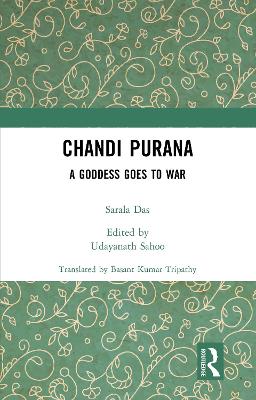
This book is the English version of Chandi Purana, written in Odia by Sarala Das. Indigenous and secular, the Chandi Purana is a shastra for laymen, a bold step towards fulfilling their right to knowledge.
This book is the English version of Chandi Purana, written in Odia by Sarala Das. Indigenous and secular, the Chandi Purana is a shastra for laymen, a bold step towards fulfilling their right to knowledge.
Based on the legend of Durga’s incarnation of Chandi, as narrated in the Vishnu Purana, Sarala Das’s Chandi Purana, written in Odia, marks the beginning of the era of classical Odia literature. It is not, however, just a renewed vernacular edition of an old story told in Sanskrit long ago; its objective is to communicate one of the great themes of Indian mythology to the common folk whom myth marginalizes and history excludes. And in doing so, the poet administers certain changes, based on local religions, beliefs, and customs. He introduces the Odia legend of Chandi by interpreting her as Sarala Chandi of Kanakpur, Odisha, where she has been ‘worshipped for one lakh and thirty-two thousand years of Kaliyuga’. Second, in Sanskrit texts, the story is told by Sage Medha to King Suratha and Samadhi Vaisya. In Chandi Purana, Sage Shuka is the narrator and King Parikshit is the listener, which reflects the poet’s adherence to Vaishnavism.
Essentially, a war story, it presents Durga not only as a goddess in war, but also as a mother figure who tears apart the patriarchal frame in which women are treated as subordinates.
Foreword A Goddess Goes to War: Claiming the Right to Modesty An
Introduction to the Odia Legend of Chandi
1. Prayer to Sri Ganesh
2. Prayer
to Goddess Sarala
3. Mahisasuras Meditation
4. Mahisasuras Conquest of
Kurancheka
5. Mahisasuras Battle with Merusula
6. Dhumralochana Ordained as
a Charioteer
7. Mahisasura Concedes Defeat to Chanda and Munda
8.
Mahisasuras Marriage with Chandrabati
9. Mahisasuras Conquest of Jambu
Island
10. Mahisasuras Battle with Shumbha and Nishumbha
11. Mahisasura
Loses the Battle
12. Mahisasuras Letter to Indra
13. Durgas Stay at
Ratnagiri
14. Mahisasura Informed of Durgas Arrival
15. The Killing of
Chanda and Munda
16. The Killing of Shumbha and Nishumbha
17. The Killing of
Chamara and Bemala
18. The Killing of Kantimala, Raktabirjya, Biraghanta,
Kaladanda and Bidulaksha
19. The Tale of Bailochana
20. The Demon Commanders
Challenge Durga
21. Mahisasura Proceeds to the Battlefield
22. The Killing of
Kalabimochana
23. The Killing of Mahisasura
Sarala Das (15th century) A shudra by caste and a farmer by occupation, Sarala Das was a great devotee of Sarala Chandi whom he considered his mother and his guide throughout his literary career. The poet of common man, he wrote epics such as the Bichitra Ramayana, the Mahabharata, and the Chandi Purana which immortalized him.
Udayanath Sahoo is the Chair Professor of Adikabi Sarala Das Chair of Odia Studies at Centre of Indian Languages, Jawaharlal Nehru University, New Delhi having 40 years of teaching and Research experience.
Basant Kumar Tripathy is a poet and translator. He has co-translated Phakirmohans Atmacharita and Lachhama. Some of his other translations are: Tika Gobindachandra, Mathura Mangala and Bichitra Ramayana.
Urmishree Bedamatta teaches English language and literature at Ravenshaw University, Cuttack, Odisha. For research, she engages mostly with Odia texts and manuscripts with a focus on the needs of the twenty-first century reader.

 Lisainfo e-raamatute kohta