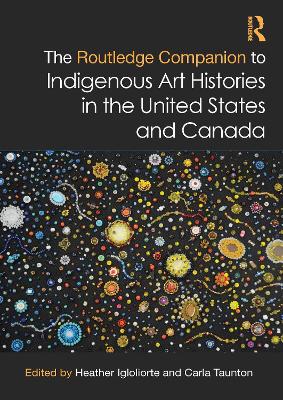
This companion consists of chapters that focus on and bring forward critical theories and productive methodologies for Indigenous art history in North America.
This book makes a major and original contribution to the fields of Indigenous visual arts, professional curatorial practice, graduate-level curriculum development, and academic research. The contributors expand, create, establish and define Indigenous theoretical and methodological approaches for the production, discussion, and writing of Indigenous art histories.
Bringing together scholars, curators, and artists from across the intersecting fields of Indigenous art history, critical museology, cultural studies, and curatorial practice, the companion promotes the study and dissemination of Indigenous art and stimulates new conversations on such key areas as visual sovereignty and self-determination; resurgence and resilience; land-based, embodied, and nation-specific knowledges; epistemologies and ontologies; curatorial and museological methodologies; language; decolonization and Indigenization; and collaboration, consultation, and mentorship.
This companion consists of chapters that focus on and bring forward critical theories and productive methodologies for Indigenous art history in North America.
Introduction: The Path Before Us: Generating and Foregrounding
Indigenous Art Theory and Method SECTION I Sovereignty and Futurity
1. Art,
Visual Sovereignty and Pushing Perceptions;
2. Dancing Sovereignty:
Reclaiming the Grease Trail Through Protocol, Movement, and Song
3. Shifting
the Paradigm of Art History A Multi-sited Indigenous Approach
4. An Inuit
Approach to Archival Work Based on Respect and Adaptability
5. Overclock Our
Imagination!: Mapping the Indigenous Future Imaginary
6. A Manifesto of Close
Encounters SECTION II Kinship, Care, Relationality
7. Kitchen Tables and
Beads: Space and Gesture in Contemplative and Creative Research
8. Expanding
Relationships: Beyond the Non
9. Wisdom in Beauty: Respect in Indigenous
Curation
10. Balancing Curatorial Indigenous and Queer Belonging: In
Conversation with Artist and Curator Adrian Stimson (Blackfoot Siksika
Nation)
11. Taking Good Care: Collaborative Curating and the Alberni Indian
Residential School Art Collection
12. Betraying the Object: Relational
Anxieties and Bureaucratic Care in Indigenous Collections Research
13. A
Brief Conversation on Visiting, Mentoring, The Land, and Art History SECTION
III Indigenous Ways of Knowing and Being
14. miżikosiwin: Spirit, Land and
Form Among Turtle Islands Indigenous Artists, Designers and Architects
15.
Indigenous Curation in LA: The Peoples Home: Winston Street 1974
16. The
Giving Tree: Methodologies of Generosity
17. Frontrunners as an Exploration
of Indigenous Littoral Curation
18. A:Shiwi Art History: The Strength of
Pueblo Place
19. Inuit Research Methodologies: Conversations Toward
Reclaiming Inuit Protocols with Robert Comeau
20. A Braided Process:
Decolonizing, Indigenizing, and Self-Determination
21. There are No
Metaphors: A Proposal for Dreaming Indigenous Philosophies into Studio Arts
Education SECTION IV Anti-colonial Practices
22. From Colonial Trophy Case to
Non-Colonial Keeping House
23. An Ethic of Decolonial Questioning: Exercising
the Quadruple Turn in the Arts and Culture Sector
24. Unsettling Artistic
Expectations With Two-eyed Seeing
25. Decolonizing Representation:
Ontological Transformations Through Re-mediation of Indigenous Representation
in Popular Culture and Indigenous Interventions
26. Care Full Discomfort:
Engaged Decolonial Practice, People and Admin
27. Telling the Stories of
Objects in Museum Collections: Some Thoughts and Approaches
28. Art Racism to
Indigenography Methodology
29. A Glossary of Insistence SECTION V Stories,
Living Knowledges, Continuity and Resurgence
30. Writing and Sharing Our Art
Histories: Storying Histories of Art: Activating the Visual
31. Bringing
Stories to Sites at Shore Lunch Clarkson/Mississauga
32. The Words You
Choose are Purposeful: On Inuit Writing and Editing
33. Beyond Queer
Survivance
34. Indigenous Abstraction: A Vehicle for Visioning
35. Alaska
Native Artistic Reclamation and the Persistence of Indigenous Aesthetics
36.
Foregrounding Pivalliatitsinik/Piggautigijaunikkut: Indigenous Mentorship in
Creative Spaces
Heather Igloliorte is Associate Professor of Art History at Concordia University, Canada.
Carla Taunton is Associate Professor of Art History and Contemporary Culture at NSCAD University, Canada.

 Lisainfo e-raamatute kohta