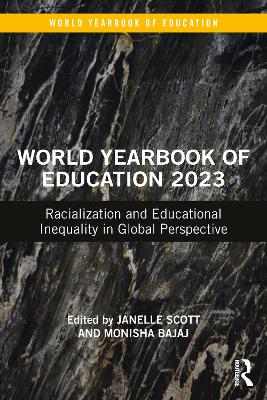
The World Yearbook of Education 2023 centers on the intersection of racialization, inequality, and education. It critically examines how racial formation and its associated logics about citizenship, belonging, justice, equality, and humanity manifest in early childhood education.
The World Yearbook of Education 2023 centers on the intersection of racialization, inequality, and education. It critically examines how racial formation and its associated logics about citizenship, belonging, justice, equality, and humanity manifest in early childhood education, primary, secondary, and higher education, as well as non-formal, community-based education settings. The chapters offer multisited perspectives into how racialization has and continues to shape educational inequality, with an eye towards the agency and resistance of youth and communities in contesting such forms of domination and marginalization.
Across three sections, the book examines how forces of imperialism, white supremacy, and colonization have shaped racialization in distinct locations and how education was historically utilized as a site for both the creation and/or reification of difference. It reveals the lingering effects of processes of racialization in distinct locations globally and their intersections with educational policies, ideologies, systems, and realities.
Inviting readers to learn, reflect, and engage with the layered and complex realities of racialization and inequality in education across the globe, World Yearbook of Education 2023 is a timely and important contribution to discussions of racialization and provides the field with a robust foundation for future critical inquiry and engagement with the themes of race, racialization, inequality, and education.
Introduction: Racialization and Educational Inequality in Transnational
Perspective. Section 1: Racialization: Theories, Discourse, and
Globalization. 1. Erasures of Racism in Education and International
Development.
2. Racialization, Whiteness, and Education.
3. Critical Race
Theory Beyond Borders: Educational Marronage and Transnational Critical Race
Theory.
4. Global Cadences of Islamophobia: Comparative Reflections on the
Racialization and Education of Muslim Youth.
5. Rejecting Abyssal Thinking in
the Language and Education of Racialized Bilinguals. Section
2. Coloniality,
Development, and Racialization in Education.
6. Education for Subordination:
Youth and the Afterlives of Coloniality and Racialization in Africa.
7.
Tomorrows Australia: Race and Racialization in Australian Education.
8.
Latinx (Im)migrant Racialization, Anti-Blackness, and the Social and
Educational Landscape of the U.S. South.
9. Race and Racialization in
Canadian Education: Schools and Universities.
10. The Racialization of
Caste: Internal Colonization and Education in South Asia. Section
3. Social
Movements, Anti-Racist Pedagogies, and Reparative Futures.
11. Racialization
and Resistance in South African Education.
12. Affirmative Action and
Racialization in the United States and Brazil.
13. Racialization, Social
Movements and Political Engagement in Brazil: The Brazilian Black Movement
and Education.
14. Racial Justice in "South-South" Internationalization of
Higher Education.
15. The Black Lives Matter at School Movement: Demanding
Educational and Racial Justice. Conclusion.
Janelle Scott is a Professor and the Birgeneau Distinguished Chair in Educational Disparities at the University of California at Berkeley. She is a Fellow of the American Educational Research Association, a Member of the National Academy of Education, and a Trustee of the Carnegie Foundation for the Advancement of Teaching. She is the editor of School Choice and Diversity: What the Evidence Says (Teachers College Press), and with Horsford & Anderson, author of The Politics of Education in an Era of Inequality: Possibilities for Democratic Schooling (Routledge).
Monisha Bajaj is Professor of International and Multicultural Education at the University of San Francisco as well as a Visiting Professor at Nelson Mandela University in South Africa. She is the editor and author of eight books and numerous articles on issues of peace, human rights, migration, racial justice, and education. She is the recipient of the Ella Baker/Septima Clark Human Rights Award (2015) from Division B of the American Educational Research Association (AERA).

 Lisainfo e-raamatute kohta